
Crash Gambling Strategy That Actually Matters
Introduction
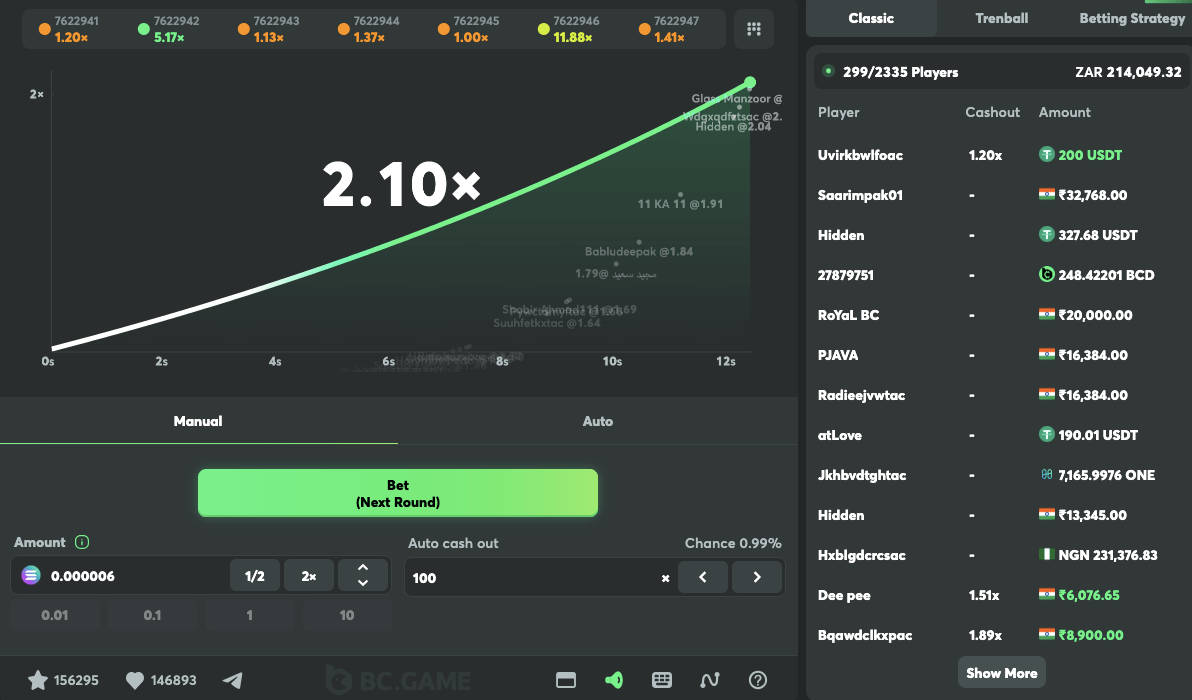
Crash gambling is a multiplayer game that combines high-speed betting with the unpredictability of algorithm-driven multipliers. In it, players wager before a multiplier begins to climb, attempting to cash out before it crashes — losing everything if they wait too long. The central appeal is the tension between greed and timing, and the potential for exponential returns.
However, behind the addictive interface lies a mathematical system governed by cryptographic randomness and fixed distribution mechanics. In 2025, the most reputable crash platforms operate under a model known as Provably Fair. This standard ensures that the game’s outcomes are generated through transparent, cryptographically verifiable processes that cannot be altered by the operator or player.
This guide does not promise profit nor trick gamblers into thinking outcomes can be accurately predicted. Instead, it offers an anti-bullshit breakdown of what strategies actually do in the real mathematical ecosystem of crash — not to beat the edge, but to manage variance.
For a complete technical foundation, see our Parent Crash Guide.
Let’s dissect the real mechanics, analyze actual variance models, document risk of ruin, and provide you the script-level tools to verify fairness.
The Mechanics (Hash Chains & Seeds)
At the core of a trustworthy crash platform in 2025 is the Provably Fair engine, a cryptographic system utilizing server seeds, client seeds, and a deterministic hashing process to generate random outcomes without bias.
Server Seed vs Client Seed
- Server Seed: Secret value generated by the game server. Typically hashed (e.g., SHA256 or SHA512) and published in advance, then later revealed for verification.
- Client Seed: Custom value provided by the user or generated by the frontend. Introduces player-specific randomness.
- Nonce: A counter of game rounds; required for uniqueness in multi-rounds between same seeds.
These three inputs are used to compute the HMAC, which translates into a crash point.
Multiplier Generation Formula
function calculateCrashPoint(serverSeed, clientSeed, nonce) {
  const crypto = require('crypto');
  const hmac = crypto.createHmac('sha256', serverSeed)
                     .update(clientSeed + ':' + nonce)
                     .digest('hex');

  const hashInt = parseInt(hmac.substring(0, 13), 16); // Take high-order bytes
  const divisor = Math.pow(2, 52);
  const result = Math.floor(100 * divisor / (divisor - (hashInt))) / 100;

  return Math.max(1.00, result);
}
If the HMAC output matches a house-controlled “instant crash” pattern (e.g., divisible by a certain value like 13), the multiplier is set to 1.00x to enforce minimum fairness.
Hash Chain Verification
The transparency lies in seed disclosure after commitment. When a session ends:
- The unhashed Server Seed is shown to players.
- Anyone can verify previous outcomes by recomputing the HMAC using the known formula.
Hash relationship:
SHA256(unhashed_server_seed_round_n) = server_seed_hash_round_n+1If this connection fails or is not transparent, the system is not Provably Fair.
Mathematical Analysis
Crash games are not random in the colloquial sense — they're algorithmically fair but statistically constrained. The major points of failure for uneducated players in 2025 are misunderstanding the role of house edge and variance.
House Edge: 2025 Landscape
| Platform | House Edge |
|---|---|
| Stake | 1.0% |
| Thunderpick | 3.0% |
| Cybet | 1.5% |
A house edge of 1% implies:
- For every $1 bet, the long-term expected return is $0.99.
- This is baked into the distribution, not modifiable by betting patterns or auto-cashout targets.
Crash Probability at 1.00x
Most crash games use a forced-probability model for instant busts at 1.00x. These occur at a fixed probability:
- Stake: ~1 in 33 (≈3.03%)
- Thunderpick: Configurable by provider (~3.8% approx.)
- Cybet: ~2%–2.5%
Variance
Variance determines how quickly a bankroll can fluctuate and deplete even with a statistically “fair” or tight payout curve.
- Low multipliers = high hit frequency, low variance.
- High multipliers = low hit frequency, extreme variance.
Long-term expected value (EV) is consistent regardless of multiplier — the variance profile shifts, not the house edge.
Strategic Analysis
False Paradigm: “Beating The Game”
Here are the top three community-favorite strategies — and the statistical reality:
- None of these eliminate the house edge.
- Some may reduce variance or optimize bankroll longevity.
Strategy 1: Martingale (Doubling After Loss)
This classic progression system assumes unlimited capital and infinite risk exposure.
| Condition | Value |
|---|---|
| Bet Sequence | $1, $2, $4, $8… |
| Profit if win occurs | $1 per winning cycle |
| Weakness | Ruin on drawdown streaks |
| Example Ruin Point | $2048 bet after 11 losses |
Martingale’s flaw is exponential exposure and flat reward. A 1.00x crash early in a Martingale cycle can eat entire bankrolls.
Strategy 2: Anti-Martingale (Paroli)
- Inverts Martingale: double after win, reset after loss.
- Leans into streaks.
- Manages risk better but susceptible to early loss after successful run.
Risk: You only bank profits after arbitrary limits. Without clear session limits, greed causes players to reinvest into eventual bust.
Strategy 3: Static Auto-Cashout
- Set a cashout point (e.g., 2.0x).
- Bet consistent size.
- Exit when crash point meets/exceeds cashout.
This manages exposure elegantly — no progressive risk behavior, but still requires knowledge of long-term hit rates.
Simulation (Flat Betting for 1,000 Rounds at 2.0x)
| Metric | Value |
|---|---|
| Auto-cashout | 2.0x |
| Empirical Hit Rate | ≈ 47% |
| ROI | ~ -1% (Stake edge) |
| Longest Loss Streak | 9 |
Strategy is resilient — if bankroll supports 10–15 sequential losses.
Strategy vs Risk of Ruin (Theoretical 5000-unit Bankroll)
| Strategy | Avg Crash Payout | Win Rate | Max Drawdown | Risk of Ruin |
|---|---|---|---|---|
| Martingale | 1.2x | 92% | Catastrophic | 40%+ |
| Anti-Martingale | 1.2 → 2.0x | 60% | Controlled | 15%-25% |
| Static @ 2.0x | 2.0x | 47% | Moderate | 10% |
| Static @ 5.0x | 5.0x | 20% | High | 45%+ |
| Static @ 10.0x | 10.0x | 10% | Extreme | 70%+ |
Fairness Audit (Manual Verification)
To verify that a crash game is Provably Fair, complete the following steps:
Step-by-Step Audit Process
- Retrieve from game history:
- Server Seed (revealed post-game)
- Client Seed (yours or default)
- Nonce (sequential round number)
- Apply this known formula:
- Compare crash_point to game’s historical round.
- Run hash chain check:
import hmac, hashlib

def verify_crash(server_seed, client_seed, nonce):
    key = server_seed.encode()
    msg = f"{client_seed}:{nonce}".encode()
    h = hmac.new(key, msg, hashlib.sha256).hexdigest()
    val = int(h[:13], 16)
    crash_point = max(1.0, round((2**52) / (2**52 - val), 2))
return crash_point# server_seed_current -> pre_hash
# server_seed_hash = sha256(server_seed)
import hashlib
hash_verify = hashlib.sha256(server_seed.encode()).hexdigest()
print(hash_verify == advertised_hash_next_round)If these do not match — platform fails verification.
Where to Play (Provider Assessment)
All below platforms are functional in 2025 and provide identifiable fairness mechanisms. Their edge varies by platform.
| Casino | Link | Edge | Best For | Verification Type |
|---|---|---|---|---|
| Stake | ▶️ Verify & Play | 1.0% | High-stakes, transparent | Full Provably Fair |
| Thunderpick | ▶️ Verify & Play | 3.0% | Crash + Esports integration | Selective |
| Cybet | ▶️ Verify & Play | 1.5% | Speed, fast withdrawal | Full Chain Disclosure |
⚠ Always confirm that seed history and HMAC process are available for audit.
Extended FAQ (2025 Technical Edition)
1. Can Hash Seeds Be Manipulated by the Platform?
Not without invalidating the seed hash commitment. Any change would cause the revealed unhashed seed to deviate from the published earlier hash, which can be instantly verified.
2. Why Do Instant 1.00x Crash Rounds Exist?
These ensure platform profitability over time. They're implemented as deterministic triggers (e.g., HMAC divisible by fixed value). Without them, statistical drift could create exploitable runs.
3. Can Strategies Like Kelly Provide Positive ROI?
Only in tightly formalized EV-positive situations (e.g., arbitrage). In crash gambling, Kelly can optimize loss reduction—not create consistent profit—unless the player knows multiplier distributions with extreme confidence.
4. Is Historical Backtesting Reliable?
If based on published round data and real seeds, yes. Demo modes often use non-identical RNG or padded volatility models, which may skew your conclusions.
5. Can You Use Bots or Scripts Safely?
Technically, yes. API-integrated platforms like Stake allow auto-settlement tools. However, if you trade speed for strategy and neglect real hit rates, you'll accelerate ruin faster.
Glossaire
| Term | Definition |
|---|---|
| Hash | A fixed-size string derived from input data via cryptographic function |
| Salt | Random enhancement added pre-hashing to strengthen cryptographic hardness |
| Crash Point | The final multiplier at which the round ends and wagers are settled/lost |
| Wager | The amount of currency placed on an individual round in crash |
| RTP | Return to Player; the theoretical amount the game returns to users (≠ EV) |