
Crash Gambling Multiplier Patterns Explained
Introduction
Crash gambling is a fast-paced, visually dynamic betting game that simulates an exponentially increasing multiplier—until it “crashes” at a random point. The objective is simple: cash out before the crash.
Technically, each round is governed by a deterministic, Provably Fair algorithm. The crash point is pre-generated using cryptographic hash chains and cannot be changed once a round starts. This ensures players can independently verify every crash outcome for fairness, randomness, and integrity.
Because of its transparent math and automation, crash gambling has become a mainstay across leading crypto casinos in 2025. However, the allure of “patterns” in the multiplier is largely psychological. Beneath the fast graphics is a right-skewed random distribution, optimized by the casino to extract a small but consistent house edge.
For players, the biggest challenges aren't timing, speed, or “intuition”, but rather understanding:
- How the multiplier is generated
- Why perceived patterns are statistical artifacts, not exploitable trends
- How strategies can alter volatility outcomes—but not expected value
In this guide, we dissect the mathematics and mechanics behind multiplier distribution in crash games.
🔬 You can learn about how the game works at a broader level in our Crash Gambling Master Guide.
The Mechanics: Hash Chains & Seeds
Crash games use cryptographic hash chains generated with a combination of server seeds, client seeds, and (optionally) nonces to produce the multiplier. The system can be verified independently by the player after each round using these components.
Server Seed vs Client Seed
| Parameter | Controlled By | Mutability | Purpose |
|---|---|---|---|
| Server Seed | Casino | Hidden until rotate | Private key for pre-generating result |
| Client Seed | Player | Adjustable | Salts the result for transparency |
| Nonce | System | Incremented each round | Uniquely identifies each round |
Overview of Multiplier Generation
- The game server pre-generates a hash chain from a seeded value (Server Seed).
- Each round, the current hash is combined with the Client Seed and Nonce to generate a unique hash.
- The multiplier (Crash Point) is derived algorithmically from this value.
Most platforms use a variation of the formula below to determine the crash multiplier:
import hashlib
import hmac
import struct

def crash_point(server_seed, nonce, client_seed):
    msg = f"{client_seed}:{nonce}"
    h = hmac.new(server_seed.encode(), msg.encode(), hashlib.sha256).hexdigest()
    r = int(h[:13], 16)
    if r % 33 == 0:
        return 1.00
    return max(1.00, (100.0 / (1 - (r / float(0x10000000000000)))))
Summary
- The multiplier is deterministic given the seed inputs.
- Seeds generate SHA-256 digests—which form the hash chain players can verify.
- If the hash modulo condition is met (e.g., divisible by 33), an instant crash (1.00x) occurs.
- Otherwise, the inverse exponential formula calculates the final multiplier.
Players can access the Server Seed (after rotation), and combine it with their own Client Seed and nonce to replicate any round.
Mathematical Analysis
House Edge in 2025
Crash games operate under a computer-enforced edge, typically 1% or 3% depending on implementation. This is achieved via:
- The instant crash condition (e.g.,
r % 33 == 0) causing 1.00x outcomes in ~3% of rounds. - The rest of the distribution following a heavy-tail viewed as an inverse exponential decay.
Unlike slot games where RTP (Return-To-Player) is tuned through payout tables, crash relies on:
M = \frac{1}{u}
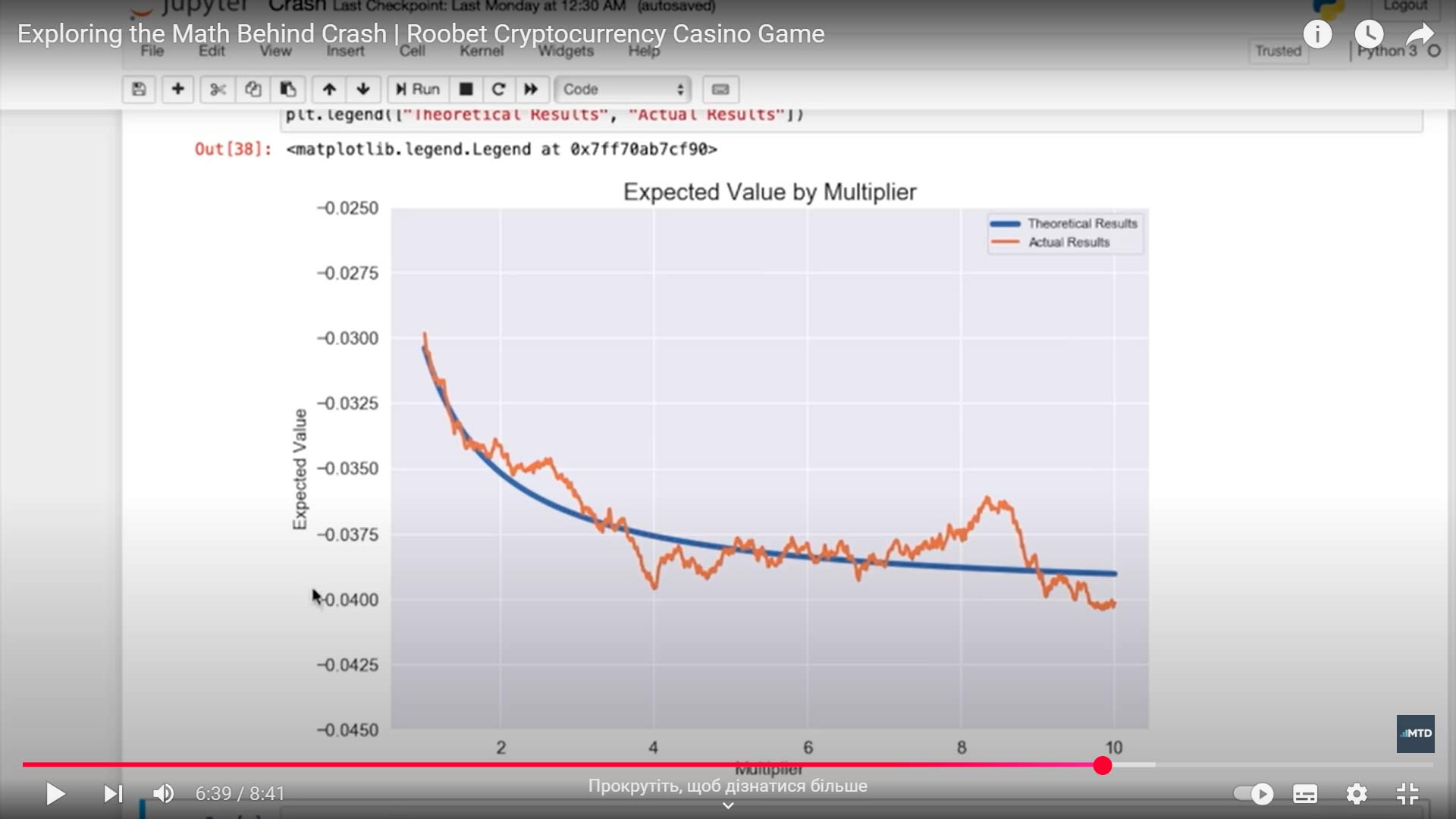
Where u \in U(0,1), a uniform random variable. Since some seeds (e.g., divisible modulo 33) enforce a 1.00x crash, the Expected Value (EV) of every round becomes:
- Slightly below parity
- Bounded by the house edge
Crashing at 1.00x — The “Fail floor”
This outcome causes immediate loss and reflects the worst-case scenario in crash. Its inclusion is necessary to force a minimum edge—even for cautious players using 1.2x or lower cashouts.
- Occurs in ~3% of rounds by deterministic rules.
- Cannot be avoided or predicted.
- Provides core margin for the house.
Variance & Distribution
Crash's underlying variance is extreme:
- Frequent low multipliers dilute winnings.
- High multipliers (10x+) are rare and often produce survivorship bias in anecdotal reports.
- Bankroll depletion is disproportionately possible in short sequences if targeting high multipliers.
This makes crash a variance-heavy negative EV game—suitable only for disciplined betting with full understanding of expected outcomes.
Strategic Analysis: Models That Manage Variance
No strategy can beat the edge. All strategies redistribute variance—changing the frequency and magnitude of wins/losses across time.
1. Flat Betting + Auto-Cashout
This is the baseline. You bet a fixed unit (e.g., $1) and always cash out at a target (e.g., 1.5x – 3.0x).
- Stable volatility
- Small, repeatable wins
- Long-term EV still negative
Simulation Example
Strategy: $1 bet, cashout at 2.0x
Win Probability: ~45%
Net payout: $1 profit per win
Expected loss per round ≈ $0.035

After 1000 rounds:
- Expected wins ≈ 450 → $450 profit
- Expected losses ≈ 550 → $550 loss
- Net: ~$100 down
2. Martingale (Doubling After Loss)
Outcome: Tries to recover with profit by doubling the bet after each loss.
Premise: You’ll eventually win before a disaster streak hits.
Example Sequence
| Round | Bet | Outcome | Cumulative |
|---|---|---|---|
| 1 | $1 | Loss | -$1 |
| 2 | $2 | Loss | -$3 |
| 3 | $4 | Win @2x | +$8 → +$5 |
Why It Fails
- Sequence is exponential:
2^nrisk behavior - Casino table limits / bankroll limits truncate progression
- Probability of 6 consecutive sub-2x crashes:
0.55^6 ≈ 2.8% - Trusted crash platforms cap bets around $10,000. Even a 7-round Martingale sequence may reach this cap.
3. Anti-Martingale (Paroli)
Outcome: Double after win, reset after loss
Focus: Capitalizing on winning streaks while limiting losing streak losses
| Round | Bet | Result | Cumulative |
|---|---|---|---|
| 1 | $1 | Win | +$1 |
| 2 | $2 | Win | +$3 |
| 3 | $4 | Loss | -$1 net |
Best suited in environments where RNG clumping exaggerates streaks (not crash). Low long-term efficiency in crash due to high entropy.
Risk of Ruin: Simulation Table
| Strategy | Bankroll Needed (for 1.2x) | # of Consecutive Losses to Ruin | Risk of Ruin | Scalability |
|---|---|---|---|---|
| Flat Auto-Cashout | $100 | 100 | Low | High |
| Martingale (2x) | $2,047 | 11 | Medium | Low (bet cap) |
| Anti-Martingale | $100 | N/A (resets on loss) | Medium | Medium |
| YOLO (10x targets) | $500 | 6 failed runs wipes bankroll | Very High | None |
Always analyze in terms of bankroll survival—not expected profit.
Fairness Audit
Every provably fair crash game allows you to manually verify each round using the seed data.
What You Need
- Server Seed (revealed post-rotation)
- Client Seed (your own input)
- Nonce (the game round count)
- Algorithm used for multiplier generation
Sample Python Code to Verify a Multiplier
import hmac
import hashlib

def get_multiplier(server_seed, nonce, client_seed):
    msg = f"{client_seed}:{nonce}"
    hash_digest = hmac.new(bytes(server_seed, 'utf-8'), bytes(msg, 'utf-8'), hashlib.sha256).hexdigest()
    r = int(hash_digest[:13], 16)
    if r % 33 == 0:
        return 1.00
    return round(max(1.00, 100.0 / (1 - (r / float(0x10000000000000)))), 2)

# Example
server_seed = "f7a23bc9a..."
client_seed = "myseed2025"
nonce = 1024

print(get_multiplier(server_seed, nonce, client_seed))
Red Flags for Inauthentic Platforms
- No access to previous seeds or hashes
- Absence of client seed customization
- Inability to reproduce outcome with seed data
- Opaque “black box” multiplier logic
Fair games make raw mathematical formulas digestible—and verifiable.
Where to Play: 2025 Trusted Platforms
| Casino | Link | House Edge | Seed Tools Available | Unique Benefits |
|---|---|---|---|---|
| TrustDice | ▶️ Verify & Play | 1% | Yes | Free faucet, public hash chain, scraping allowed |
| cybetplay.com/tluy6cbpp | ▶️ Verify & Play | 1% | Yes | Script support, community lobbies |
| Stake | ▶️ Verify & Play | 1% | Yes | High betting limits, robust hash distribution |
👉 Choose platforms that fully display Client Seed, Server Seed, and hash digest data per round.
Extended FAQ
- ❓ How can I verify a 1.00x crash isn’t fake?
✅ Use the provided server/client seed + nonce and apply the modulo 33 condition in the original hash to confirm if the result should be instant crash. - ❓ Can I automate my bets using a script?
✅ Yes. cybetplay.com/tluy6cbpp supports custom scripting natively. TrustDice and Stake offer APIs or browser-based scripting via JavaScript injection. - ❓ Why do some rounds seem to “repeat” the same multiplier?
✅ Due to uniform RNG and extremely granular value mapping (64-bit space), similar-looking outcomes are not evidence of patterns. They're statistical overlap. - ❓ Are withdrawals delayed based on performance?
✅ At legitimate platforms (see table), withdrawals are instant or near-instant. If performance causes delays, that's a red flag—cash out and exit. - ❓ Does changing my client seed help?
✅ No, the client seed only personalizes your seed chain for transparency. It does not impact the house edge or change your outcome odds.
Glossary
| Term | Definition |
|---|---|
| Hash | A one-way cryptographic output used to validate integrity of data |
| Salt | An additional input that modifies hash results to prevent precomputation |
| Crash point | The multiplier at which the game ends for a round |
| Wager | The amount of money or crypto bet per game iteration |
| RTP | Return-To-Player: expected payout percentage over large sample size |
Crash gambling in 2025 is mathematically predictable in expectation—but riddled with high volatility, variance spikes, and emotional traps. Trust the formulas, not your gut.