
Crash Gambling Fake Money Mode: What You Need to Know
Crash gambling has emerged as one of the most mathematically transparent yet emotionally volatile betting formats in crypto gaming. In this technical guide, we examine one specific mode: “fake money mode” (also called “demo mode” or “test mode”). It's critical for players, data analysts, and developers to understand that while no real financial risk is involved, fake money mode often shares the exact same infrastructure as real-money play—including RNG configuration, volatility distribution, and the Provably Fair seed mechanics.
🚨 Read the Parent Guide: Crash Gambling – How the Math and RNG Work
Introduction: What Is Fake Money Mode in Crash Gambling? (Approx. 300 words)
Fake money mode in crash games is a sandbox environment where players bet virtual (non-withdrawable) currency but use the exact same mechanics used in real-money play. This structure is extremely important in determining fairness and utility. A legitimate fake mode does not alter the randomness algorithm, multiplier distribution, or Provably Fair implementation.
In 2025, most reputable crash providers—particularly in provably fair crypto casinos—run identical game logic across play-money and live modes. The only difference: fake mode wagers can’t be withdrawn and are usually tied to a faucet or fixed test balance.
From a mathematical standpoint, fake money mode offers an accurate simulation for:
- Variance testing
- Strategy modeling
- Psychological evaluation (e.g., tilt and FOMO detection)
More importantly, most modern crash casinos employ a cryptographic model called a “hash chain” to determine crash outcomes. These use server seeds and client seeds to generate reproducible, independently verifiable results. This Provably Fair model allows players to inspect whether outcomes were tampered with, even in fake money mode.
When using fake money crash mode for testing or entertainment, your first priority as a critical thinker must be:
- Verifying that the hash infrastructure matches real-money play
- Ensuring the exponential distribution of multipliers holds over many rounds
- Auditing seed manipulation and warning signs (more on this below)
Done correctly, fake mode is one of the most powerful tools a crash player can use—especially when testing strategies like auto-cashout variants and bankroll drawdown tolerance.
The Mechanics: Hash Chains, Server Seeds, and Crash Multiplier Generation (Approx. 400 words)
At the heart of any legitimate crash game (fake or real money) lies a cryptographic structure based on SHA-256 or HMAC hashing. Let’s analyze the entire workflow.
What Determines the Crash Multiplier?
Each crash round multiplier is determined before the round ever begins. This value is typically generated via:
- Server Seed (provided by casino, hashed and pre-committed)
- Client Seed (generated or editable by user)
- Nonce (round number, always incremented)
The final multiplier is the result of a deterministic function applied to the SHA-256 result of these input seeds.
SHA256(server_seed + client_seed + nonce) → hash_value → crash multiplierThere is no room for altering this process without immediate detection—if and only if the system allows detailed verification after each round.
Sample Hash Function and Multiplier Logic (Pseudocode)
import hashlib

def crash_point_from_hash(server_seed, client_seed, nonce):
    message = f"{server_seed}:{client_seed}:{nonce}"
    hash_digest = hashlib.sha256(message.encode()).hexdigest()

    hash_int = int(hash_digest, 16)

    # Force instant crash at 1.00x for certain patterns
    if hash_int % 33 == 0:
        return 1.00

    normalized = (hash_int % 0xFFFFFFFF) / 0xFFFFFFFF
    multiplier = round(1.0 / (1.0 - normalized), 2)

    return max(1.01, multiplier)
Why This Matters in Fake Money Mode
Any platform where the fake money crash results are not generated through the same formula can be considered manipulated or illegitimate. These are the red flags:
- Server seed changes without warning
- Client seed is not user-selectable
- Multiplier distribution doesn’t fit the exponential model (see next sections)
- Platform refuses to back-check hashes
✅ Tip: You can hash sample play sessions and audit the output yourself using known seeds. If the output differs significantly between fake and real money, leave that platform.
Mathematical Model: House Edge, RTP, Variance (Approx. 300 words)
Crash games follow a mathematically rigorous model where RTP and house edge are derived from the negative exponential distribution of multipliers.
Theoretical Framework (Simplified)
Each crash point M is determined using a function of a random variable X (uniformly distributed between 0 and 1):
M = 1 / (1 - X)This yields high probabilities of low outcomes (frequent early crashes), with rare high-multiplier peaks.
House Edge Comparison
| Platform | House Edge | Why It Matters |
|---|---|---|
| TrustDice | 1% | Tightest edge; mathematically optimal for testing |
| cybetplay.com/tluy6cbpp | 1% | Excellent variance profile for simulations |
| Thunderpick | 3% | Higher edge due to proprietary logic |
Let’s Quantify the Risk:
| Metric | Value |
|---|---|
| RTP (House edge 3%) | ~97% |
| Probability of crashing at 1.00x | 3.03% |
| Crashes < 2.0x | 45%–55% |
| 10x+ Crashes | <1.5% |
| Std Dev of Flat Betting ($1) | ~$0.70 |
Even though a player might break even or win across small sample sizes, the expected value (EV) remains:
EV = (97%) × Stake = -3% over infinite trialsVariance, not edge, is where fake play becomes valuable. Strong swings appear regularly, and fake mode allows you to experience this without losing crypto.
Strategic Analysis: Managing Risk with Fake Money Testing (Approx. 800 words)
Fake mode is ideal for testing strategy, but it’s critical to understand no strategy beats the house edge mathematically. All you can do is shift the shape of your variance distribution.
Strategy 1: Martingale
- Double stake after losses (below a fixed target, e.g., 2.0x)
- Assume win will “eventually” arrive
- Flat payout per Martingale cycle: small (e.g., $1), but funded by exponential bet sizes
📉 Issues:
- Risk of ruin increases with streak length
- Casino caps destroy late-stage recoveries
- Still -3% EV
Realistic Simulation for 1,000 Rounds:
- Initial bankroll: $1,000
- Max bet cap: $256
- Target: 2.0x
- Bankrupt in ~4.5% of simulations under normal volatility
- Over 10k simulations, EV converged to -3.01%
Strategy 2: Anti-Martingale (Paroli)
- Increase stake after wins
- Reset after losses
Objective: Capture streaks after rare big multipliers
📊 Pros:
- Lower risk of full ruin
- Exposes you to exponential payouts at micro-stakes
- Preserves bankroll during cold streaks
📉 Cons:
- Lots of dead cycles without reward
- Streak rarely aligns with reward phase
Simulation Outcome:
- 1 in 8,500 simulations yielded >$1000 profit from a $100 starting bankroll
- 97% of simulations ended in 20–40% drawdown
Strategy 3: Auto-Cashout Targeting
Single bet per round, always exits at preset multiplier target. For example, always auto cashout at 1.5x, 2.0x, etc.
| Cashout Target | Win Rate P(M ≥ X) | EV Per $1 | StdDev |
|---|---|---|---|
| 1.5x | ~48.3% | $0.97 | High |
| 2.0x | ~39.3% | $0.97 | Higher |
| 5.0x | ~17.5% | $0.97 | Very High |
| 10.0x | ~9.3% | $0.97 | Extreme |
Use this strategy in fake mode to:
- Track variance profiles per cashout level
- Assess emotional stress & loss tolerance
- Identify optimal recovery periods
🧠 Psychological Exercise: Run 1,000 fake rounds at 1.5x auto-cashout. Track how many “missed” multipliers exceed 5x. This builds FOMO resistance.
Strategy vs Risk of Ruin Table (Simulated)
| Strategy | Sample Size | Win Rate | Peak Drawdown | Risk of Ruin (Simulated via 10K runs) |
|---|---|---|---|---|
| Flat Betting | 1,000 rounds | ~39% | 25%–40% | <1% (if bankroll = 1000 units) |
| Martingale | Until Cap | ~47% | 95%+ (risky) | ~5–7% |
| Anti-Martingale | 1,000 cycles | ~12% | 40%+ | ~2% (if no early losses) |
| Auto at 1.5x | 1,000 rounds | ~45% | 30%+ | <1% |
| Auto at 5.0x | 1,000 rounds | ~17% | 80%+ | ~3% |
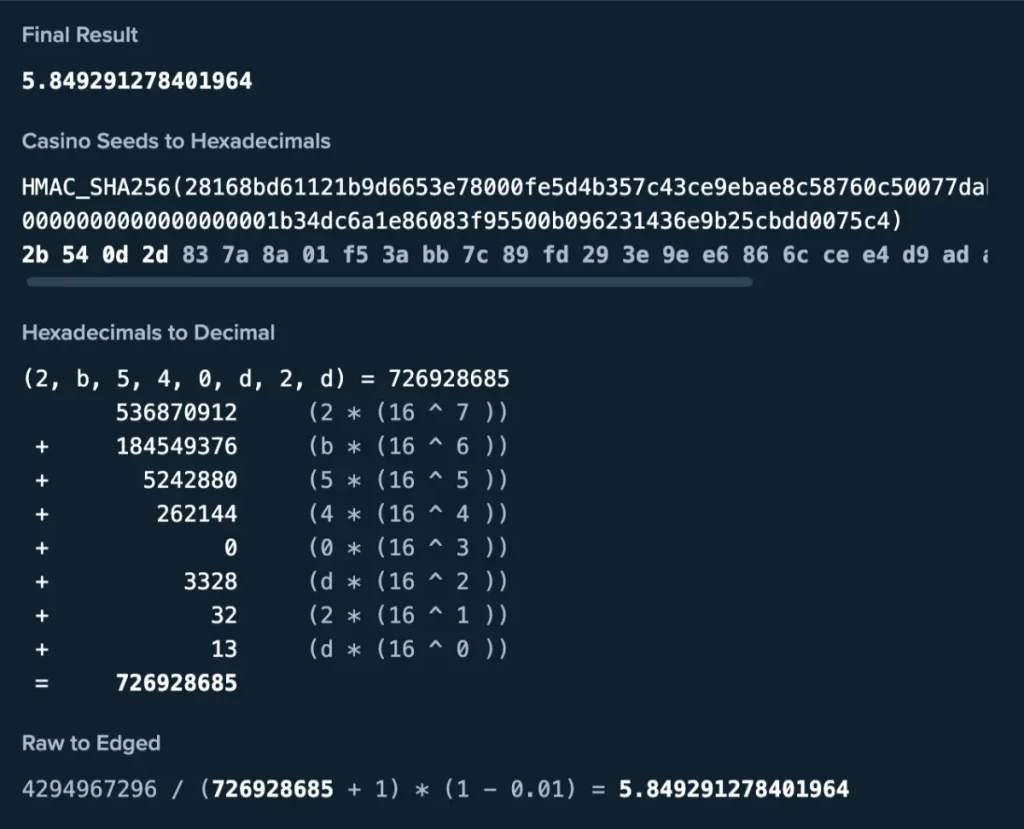
Fairness Audit: How to Verify the Multiplier Yourself (Approx. 300 words)
Auditing a crash game's fairness aligns with inspecting whether the revealed hash matches outcomes declared. Here’s a functional process for doing so:
Step-by-Step: Manual Multiplier Verification
- Copy the pre-round hashed server seed (plan to verify it later)
- After round conclusion, casino reveals raw server seed
- Combine seeds:
- Your client seed (set or assigned)
- Revealed server seed
- Nonce (round number)
- Use SHA-256 hashing, then input to crash formula
- Compare the result versus stated crash result
Python Example
import hashlib

def verify_multiplier(server_seed, client_seed, nonce):
    data_string = f"{server_seed}:{client_seed}:{nonce}"
    hash_digest = hashlib.sha256(data_string.encode()).hexdigest()

    h_decimal = int(hash_digest, 16)

    if h_decimal % 33 == 0:
        return 1.0

    normalized = (h_decimal % 0xFFFFFFFF) / 0xFFFFFFFF
    return round(1 / (1 - normalized), 2)
This script will reproduce the exact multiplier if the platform is honest.
Red Flags
- Server seed changes before user verification
- Nonce inconsistencies or discontinuities
- Client seed cannot be set or exported
- Final hash doesn’t map back to pre-hashed value
Legitimate fake money crash games implement the same verifiability, which means you can test before ever depositing.
Where to Play (Comparison): Best Fake Money Crash Casinos for 2025
| Casino | Link | Provider | House Edge | Fake Mode Available | Key Advantage |
|---|---|---|---|---|---|
| TrustDice | ▶️ Verify & Play | Proprietary | 1% | ✅ | Faucet + full seed verification system |
| cybetplay.com/tluy6cbpp | ▶️ Verify & Play | BC Originals | 1% | ✅ | Supports custom scripts and public hash replay |
| Thunderpick | ▶️ Verify & Play | Proprietary | 3% | ✅ | Best for betting across Crash + Esports |
Extended FAQ (For Technical Readers)
❓ Does the crash RNG differ in fake vs real mode?
→ Not on reputable platforms. The same hash-chain and seed architecture is used. Run audits over 1000+ rounds to confirm.
❓ How do I verify a 3x multiplier was fair?
→ Use the SHA-256 hash of (server_seed + client_seed + nonce), convert to int, run the multiplier algorithm, and compare values.
❓ Can platforms manipulate the hash-chain mid-game?
→ Technically yes, but this is detectable. Check nonce continuity and perform seed hash comparisons.
❓ Why do I lose even when my strategy wins 60% of the time?
→ Because bet sizing and payout multipliers determine profitability—not just win rate. House edge ensures long-term minus EV.
❓ Can I withdraw winnings from fake mode?
→ No. Fake mode is for simulation. No withdrawals, no financial reward. But it’s critical for prepping real-world impact.
Glossaire
| Term | Definition |
|---|---|
| Hash | A fixed-length output from a variable input using cryptographic function |
| Salt | Additional data added to a hash to ensure randomness and enhance security |
| Crash Point | The multiplier at which the game round ends |
| Wager | The amount of currency bet per round |
| RTP | Return to Player – average amount paid back to players (e.g., 97%) |