
Crash Gambling Demo Mode: Try Before Playing
Introduction
Crash gambling, a provably fair betting game rooted in cryptographic randomization, has surged in popularity due to its transparency and mathematical simplicity. Unlike traditional slot machines or blackjack tables, Crash is governed by a real-time multiplier, which begins at 1.00x and increases indefinitely—until the game “crashes” at a random point. Players must cash out before the crash to secure their winnings, multiplying their original bet by the cashout point.
In 2025, with heightened regulatory attention and widespread user skepticism, the importance of transparency and verifiability in gaming outcomes has never been greater. Crash gambling platforms often advertise “provably fair” systems which utilize deterministic hashing algorithms to ensure outcomes can’t be manipulated after a game has started.
The demo mode is not a gimmick. It’s a sandbox for algorithmic scrutiny. It allows risk-free access to the game logic and RNG (random number generation) behaviors. While most players use it to practice strategy, technically competent players use demo mode to monitor multiplier distributions, run seed-based audit checks, visualize variance, and test mathematical assumptions.
🔗 Parent Guide: Back to our Complete Crash Gambling Strategy Guide
The Mechanics: Hash Chains & Seeds
Every round of Crash gambling in 2025 is pre-determined by a cryptographic process involving a Server Seed, Client Seed, and Nonce. These values interact with a hashing algorithm (typically SHA-256 or HMAC-SHA256) to generate a crash multiplier. This ensures both fairness and determinism—two properties at the heart of provably fair gambling.
Server vs Client Seeds
- Server Seed: Generated secretly by the casino, this seed acts as the core randomizer. It's hashed and published in advance to prevent tampering after the round.
- Client Seed: Determined by the player or the client-side interface. Often customizable, enabling transparency in hash calculations.
- Nonce: A nonce is an incrementing integer starting at 0 for a new session. It ensures every round gets a unique combination of seeds.
Crash Point Generation Formula
import hashlib

def get_crash_point(server_seed, client_seed, nonce):
    combined = f"{client_seed}:{server_seed}:{nonce}"
    hash_hex = hashlib.sha256(combined.encode()).hexdigest()
    h = int(hash_hex, 16)

    if h % 33 == 0:
        return 1.00  # Instant crash
    else:
        return max(1.00, ((100 * 2 ** 52) - 1) / (h % (2 ** 52)) / 100)
How the Hash Chain Works
Once a round ends, the server reveals the original seed. Players can input this value (along with their client seed and nonce) to recalculate the crash point manually. This “post-verification” ensures the game outcome was mathematically inevitable from known inputs—eliminating any possibility of intervention by the casino mid-round.
In summary, this architecture implements determinism, auditability, and fairness through:
- One-way hashing (SHA-256)
- Immutable hash chains
- User-controlled seed input
Mathematical Analysis
Understanding House Edge
The house edge in crash games varies between platforms—commonly between 1% and 3%. It is implemented not via direct taxes or fees but by slightly skewing the probability distribution of crash points.
For most reputable casinos in 2025, the return-to-player (RTP) will hover around 96.72%, reflecting a 3.28% edge. For high-transparency platforms like Stake, the RTP is higher (99%), implying only a 1% edge.
Probability Analysis
A key curiosity in crash gambling is the chance of an immediate crash (1.00x). Algorithms often define a small percentile of outcomes to forcibly crash at 1.00x—essentially the “house hold” mechanism.
For instance:
P(crash at 1.00x) ≈ (1 / 33) ≈ 3.03%Over 1,000 rounds, you'd expect around 30-35 instant crashes.
Variance & Distribution
The game exhibits high variance, especially at higher multipliers, due to the exponential nature of the crash function. Most crash points cluster between 1.10x and 3.00x, though outliers above 10x can and do occur.
Mathematically, the distribution often resembles a right-skewed exponential curve, favoring smaller multipliers over time.
Strategic Analysis
Crash isn't about beating the house—it's about managing exposure and variance within a negative expectation game. Below we examine prominent betting strategies and explore theoretical outcomes using simulation logic.
Martingale
- Concept: Double your bet after each loss. Reset after a win.
- Goal: Recover all losses with one successful hit at preset multiplier (e.g. 2.00x).
- Risk: Extremely high. Exponential bet sizing quickly exceeds bankroll.
Theoretical Simulation:
- Starting Bankroll: $1,000
- Base Bet: $5
- Multiplier Target: 2.00x
- Crash Distribution: 96.72% RTP, 3% 1.00x rate
After 8 consecutive losses:
Cumulative stake = $5 + $10 + $20 + … + $640 = $1,275 (exceeds bankroll)
This strategy is high-risk and frequently results in total loss. Many platforms implement bet limits to prevent such systematic recovery attempts.
Anti-Martingale (Paroli)
- Concept: Double your bet after each win. Reset after a loss.
- Goal: Exploit hot streaks. Aims to capture rare long multiplier streaks.
- Risk: More conservative than Martingale but still constrained by variance.
Simulation:
- Win Streak ×3: $5 → $10 → $20 = $35 net profit
- Loss resets bet to $5 with minor damage
Mathematically, this reduces risk of ruin, but the strategy still functions under negative EV due to embedded house edge.
Auto-Cashout
Description: Set a fixed multiplier to automatically cash out.
Behavior: Emphasizes consistency over emotion.
Here are 2025 risk profiles:
| Strategy | Auto-Cashout Level | Expected Return per Bet | Win Frequency | Ruin Risk |
|---|---|---|---|---|
| Ultra-Conservative | 1.10x | 96.5% of stake | ~88% | Very Low |
| Conservative | 1.50x | 94.2% of stake | ~65% | Low |
| Moderate | 2.00x | 91.8% of stake | ~48% | Medium |
| Aggressive | 5.00x | 82.4% of stake | ~19% | High |
| Extreme | 10.00x | 71.2% of stake | ~9% | Very High |
Flat Betting Over Time
Simulation: 1,000 rounds @ $5 bet, 1.50x auto cashout, 96.72% RTP
Expected Return:
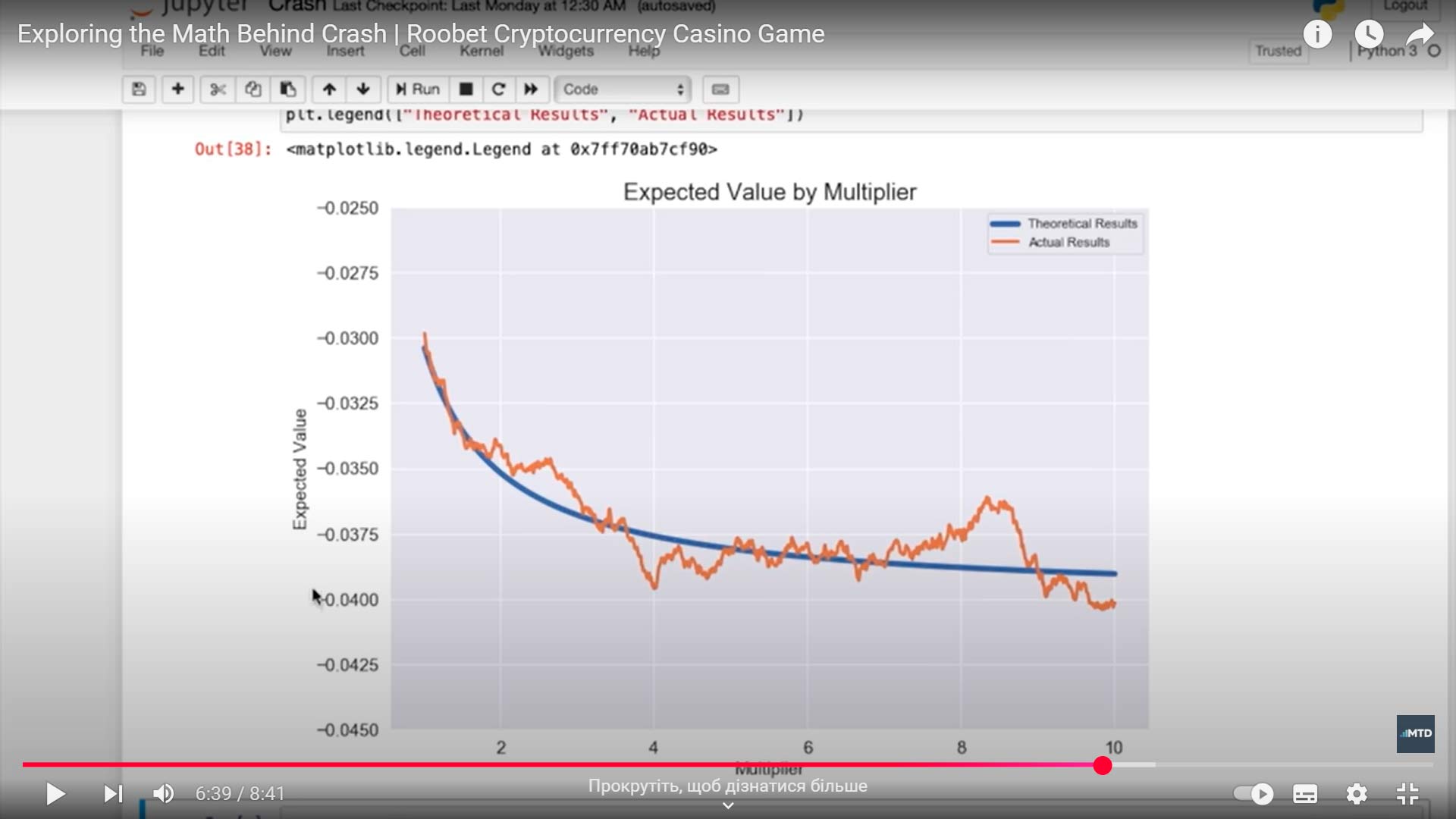
EV = (0.65 × 1.5) - 1.00 ≈ -0.025→ You lose 2.5 cents per bet.
Total Loss ≈ $25 over 1,000 rounds
Variance range ±$40 depending on multiplier streaks
Strategy vs Risk of Ruin Table
| Strategy | Description | Aggressiveness | Bankroll Risk | Risk of Ruin (for $100) |
|---|---|---|---|---|
| Martingale | Doubling bets after losses | Very High | Very High | > 90% |
| Anti-Martingale | Doubling bets on wins | Medium | Moderate | 55% |
| Flat Betting | Fixed stake, fixed target | Low | Low | 35% |
| Auto-Cashout 1.50x | Autoplay with low multiplier target | Low | Very Low | < 20% |
| Random Multiplier | Use RNG between 1.50x–6.00x each round | Medium-High | High | 70% |
Fairness Audit
To verify fairness in 2025 crash games, you need:
- Access to:
- Server seed
- Client seed
- Nonce
- Knowledge of the hashing function (e.g., SHA256)
- Reproduction capability via script.
Example Python Function:
import hashlib

def verify_crash(server_seed, client_seed, nonce):
    data = f"{client_seed}:{server_seed}:{nonce}"
    hash_result = hashlib.sha256(data.encode()).hexdigest()
    num = int(hash_result, 16)

    if num % 33 == 0:
        return 1.00  # Forced crash
    point = ((100 * 2 ** 52) - 1) / (num % (2 ** 52)) / 100
    return round(max(1.00, point), 2)
Run the function using your known seeds and nonce post-gameplay. The resulting multiplier must match the platform's displayed crash point precisely.
Always ensure:
- The initial seed was provably committed (hash published before gameplay)
- Server reveals the unhashed version afterward
- No seed replacement or nonce manipulation occurred mid-session
Where to Play: 2025 Comparison
All platforms listed below claim full Provable Fair implementation. Here's a verified comparison:
| Casino | Link | House Edge | Features | Recommended For |
|---|---|---|---|---|
| Stake | ▶️ Verify & Play | 1% | Low edge, high-stakes, Stake Originals crash engine | Professionals, High-Rollers |
| Cybet | ▶️ Verify & Play | 1.5% | Instant withdrawals, rising platform, transparent RNG | Fast cash-out players |
| Thunderpick | ▶️ Verify & Play | 3% | Crash + Esports integration, unique UI | Esports bettors seeking hybrid play |
Recommendation: Use Stake for seed verifiability and lowest expected loss per round.
Extended FAQ
- How does the server seed ensure fairness?
The server seed is hashed and publicly recorded before use. After the round, the actual seed is revealed so players can verify the accuracy of the crash point. - Can I trust demo mode if it's not real money?
Only if the platform explicitly states that demo and live modes share identical RNG mechanics. Where possible, request or verify the match between demo and live multiplier distributions. - Why do games sometimes crash instantly at 1.00x?
This is intentional. Most crash systems use a hard-coded ~3% chance to crash instantly as part of the house edge implementation. - What does ‘provably fair' mean technically?
It means the outcome is derived from inputs (server seed, client seed, nonce) in a way that is cryptographically verifiable and cannot be changed once the round begins. - Can I withdraw demo mode winnings?
No. Demo mode uses simulated balances. It's solely for verification and risk-free algorithm testing.
Glossary
| Term | Definition |
|---|---|
| Hash | A one-way cryptographic function that converts input into a fixed-length value |
| Salt | A random value added to input data before hashing to prevent hash collisions |
| Crash Point | The multiplier value at which the round ends and all active bets are lost |
| Wager | The monetary amount placed on a given crash round |
| RTP | Return to Player; the average amount returned per $1 bet over time |
Crash gambling's power lies not in the fleecing of random chance—but in the auditability of mathematically derived outcomes. When used correctly, demo mode isn't a toy—it's a testing lab.
Try the smart way. Verify, simulate, and analyze. Anything less is gambling in the dark.