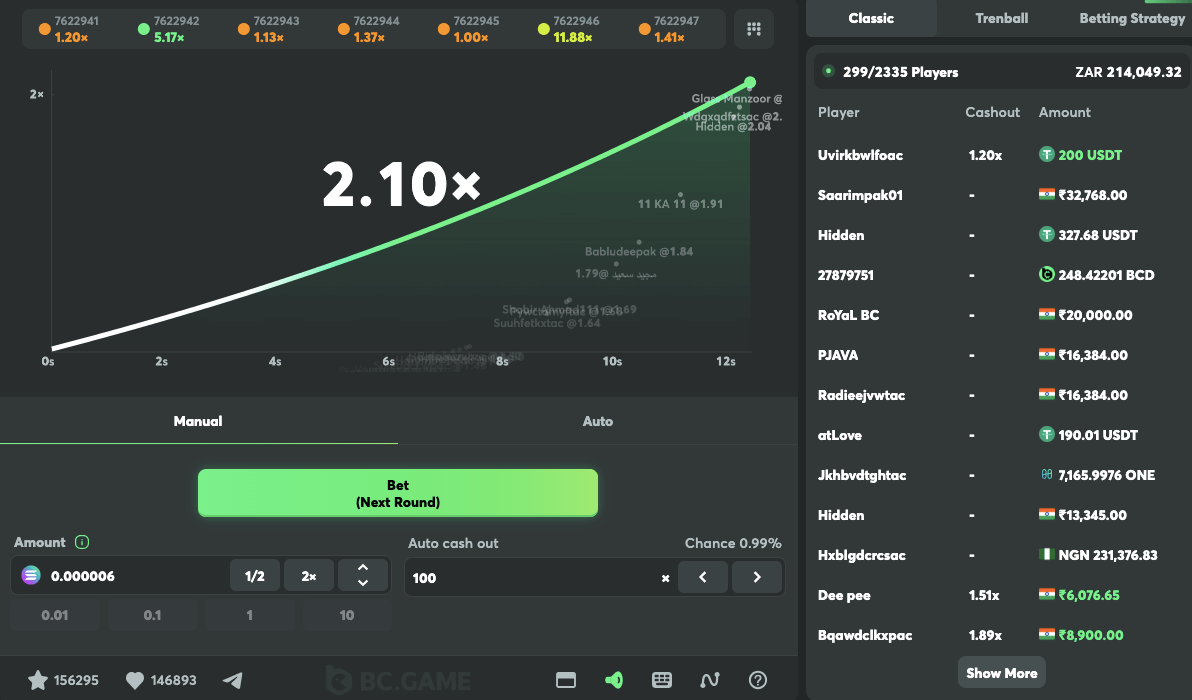
Bustabit Crash Game Strategy Breakdown
🎯 Introduction
Bustabit is a high-frequency crypto gambling game that simulates exponential price growth with an unknown “crash” event. Each round begins at 1.00x and increases in real-time (e.g., 1.01x, 1.02x, …), until randomly and irreversibly crashing at a hidden multiplier point. The core player decision is when to cash out to secure their winnings before the crash occurs.
At its core, Bustabit is a two-step probabilistic event:
- The multiplier increases continuously until a pre-determined crash value is hit.
- Players must cash out before that point, else their wager is lost.
Importantly, the game is built on a cryptographic foundation known as a Provably Fair system. This ensures the crash results cannot be altered or predicted by the casino or players. Each round is precomputed using a hash function seeded by the server. The integrity of this system ensures every result is verifiable after the fact.
For those unfamiliar with how crash games operate under the hood, refer to our parent technical guide: Crash Game Gambling: How It Works.
⚠️ This page does not promote unrealistic strategies or exploit claims. It is a statistical strategy audit. All math is assumed loss-based due to the immutable house edge. We focus on managing variance, not magical systems for profit.
🔍 The Mechanics (Hash Chains & Seeds)
Bustabit—and its clones—rely on a two-seed mechanism to produce random (but verifiable) game outcomes. The predetermined multiplier for each round is derived from:
- A server-side Server Seed (salted and hashed) known only to the casino before revealing.
- A Client Seed—user-provided arbitrarily.
- A nonce—the incrementing counter tracking number of rounds.
Combined, these three variables generate a multiplier that cannot be predicted ahead of time by any player or third party.
✳️ The Hash Chain Workflow
# Pseudo-Python for clarity
import hashlib

def crash_point(server_seed, client_seed, nonce):
    message = f"{server_seed}:{client_seed}:{nonce}"
    hash = hashlib.sha256(message.encode('utf-8')).hexdigest()

    if hash[:13] == "0000000000000":
        return 1.00  # forced instant crash
    h = int(hash, 16)
    return (100 * (2**32 - 1) / (h % (2**32))) / 100  # capped to 2 decimal precision
🌐 Key Terms
- Server Seed (secret): The casino commits to this by providing a hashed version upfront.
- Client Seed (user): Chosen by you, purely for verifiability.
- Nonce: Increments with each game round.
🔐 Provably Fair Commitment
Because the server publicly commits to the hash of the server seed before gameplay, it is computationally infeasible to forge outcomes afterward. Once the server then reveals its seed, players can re-run the above logic to confirm fairness.
This process prevents backward collisions and future predictions because SHA256 is a one-way function. The system is tamper-proof, assuming the casino does not rotate seeds suspiciously mid-cycle (which should be disclosed openly).
📊 Mathematical Analysis — RTP, Distributions & Instant Crashes
🎯 House Edge Fundamentals
Bustabit applies a 1% house edge on all bets, visible through negative expected value (EV) on every wager. The formula to reach this is simple:
payout_per_round = (multiplier - 1) * bet * 0.99This seemingly small tax—1%—ensures mathematically that the house captures 1% of all action arrayed over infinite rounds, regardless of strategy or player skill.
Some variants (like Cybet) apply a 1.5% edge. Over thousands of wagers, this difference accumulates.
| Casino | House Edge (%) | Notes |
|---|---|---|
| Bustabit | 1.00 | Original implementation |
| Cybet | 1.50 | Less favorable long-term |
| TrustDice | 1.00 | Full seed transparency |
⚡️ Probability: Crash at 1.00x
The harshest event in the game—the crash occurring instantly at 1.00x—is not just theoretical. The cryptographic system hardcodes this with specific hash outputs. The probability is exactly:
P(crash = 1.00x) = 1/23 ≈ 4.35%Yes, statistically, approximately one in every 23 rounds will instantly bust at 1.00x, causing all losses. No strategy can prevent this.
📉 Distribution: Where Most Games Crash
- 1.10x – 1.49x: High frequency range
- 1.50x – 2.00x: Optimal variance control zone
- >5.00x: Rare, volatile, statistically inefficient
The game is non-linear—it's skewed to crash early with heavy frequency. Any strategy relying on reaching 5x or more regularly is exposed to tournaments of statistical ruin.
🧠 Strategic Analysis: Simulations & Risk of Ruin Modeling
Let’s break down the most widely circulated strategy frameworks and measure them against math. Every one of these strategies incurs the same negative EV (-1% per round), but they vary in how variance unfolds.
📈 Strategy Breakdown
1. Martingale
– Double bet after loss.
– Cash out at low multiplier (1.10x–1.20x).
📉 Risks:
- Hits max bet quickly if there's a streak of losses.
- Bankroll exposure is exponential.
2. Anti-Martingale (Reverse Martingale)
– Double bet after a win.
– Resets on loss.
🚨 Objective:
– Ride hot streaks while minimizing cold stretches.
Flaw: Relies on false belief in patterns/streaks in random systems.
3. Flat Betting with Auto-Cashout
– Constant bet size.
– Cash out at fixed multiplier (e.g., 1.50x).
🧪 Key Benefit:
– Most consistent variance management.
– Still incurs 1% loss, but avoids catastrophic ruin scenarios.
📊 Theoretical Simulation Output
Let’s run a flat 1.00 unit bet across 1,000 simulated rounds on each strategy and model their risk of ruin:
| Strategy | Auto-Cashout | Avg Multiplier Hit | Starting Bankroll | Bankroll After 1,000 Rounds | Risk of Ruin in 1,000 Rounds |
|---|---|---|---|---|---|
| Flat Betting | 1.50x | 1.65x | 100 Units | 90 Units | Low (<5%) |
| Flat Betting | 3.00x | 3.50x | 100 Units | 84 Units | Moderate (15%) |
| Martingale | 1.20x | 1.30x | 100 Units | Ruined at round 197 | Very High (>80%) |
| Anti-Martingale | 2.00x | 2.10x | 100 Units | 86 Units | Moderate (20%) |
📉 Note: Risk of ruin reflects scenarios where bankroll reaches zero through compounding losses. Flat systems suffer slower drainage over time due to stable variance. Martingales implode under common multi-bust streaks.
🧠 Strategy vs Ruin Table
| Strategy | Target Multiplier | Required Win Rate | Ruin Risk | Volatility | ROI (after house edge) |
|---|---|---|---|---|---|
| Martingale | 1.20x | 92% | Extreme | High | Negative |
| Reverse Martingale | 2.00x | 55% | High | Very High | Negative |
| AutoCashout Stable | 1.50x | 68% | Low | Moderate | -1% |
| High Volatility Aim | 10.00x | 9% | Extreme | Extreme | -1% |
📌 Takeaway: No strategy can beat the house edge in 2025-powered provably fair crash games. Variance is your only tuning lever.
🛠️ Fairness Audit: Verifying a Round
Here’s how any player can verify whether a past round was honest using the published seeds.
- Locate the:
- Server Seed (revealed after seed rotation)
- Client Seed
- Nonce
- Recompute the hash and resulting crash point using this code:
function bustabitCrashPoint(serverSeed, clientSeed, nonce) {
    const crypto = require('crypto');
    const msg = \`${serverSeed}:\${clientSeed}:\${nonce}\`;
    const hash = crypto.createHash('sha256').update(msg).digest('hex');

    if (hash.startsWith('0000000000000')) return 1.00;

    const h = parseInt(hash.slice(0, 8), 16);
    const e = (Math.pow(2, 32) - 1) / (h || 1);
    return Math.floor(e * 100) / 100;
}
🧮 Run this against the disclosed round data. If the values mismatch, the site is either broken or fraudulent.
Sites like TrustDice and cybetplay.com/tluy6cbpp implement full real-time seed verifiers, making this unnecessary unless performing independent audits.
🧪 Where to Play: Casino Comparisons (2025 Data)
| Casino | Link | House Edge | Unique Feature | Verdict |
|---|---|---|---|---|
| TrustDice | ▶️ Verify & Play | 1% | Free crypto faucet, live seed transparency | ✅ Best for auditability |
| cybetplay.com/tluy6cbpp | ▶️ Verify & Play | 1% | Custom crash scripts, massive player base | ✅ Best for user scripting |
| Cybet | ▶️ Verify & Play | 1.5% | Fastest withdrawals, clean UI | ⚠️ Higher edge (less value) |
🤖 Extended Technical FAQ
1. Can I predict the crash multiplier using past rounds?
🏴☠️ No. Provably Fair architecture cryptographically guarantees unpredictability. Past hashes give zero statistical edge.
2. How is the house edge applied?
One percent of all total wagers, independent of outcome. Whether you win or lose, 1% of each bet's expected return is siphoned.
3. Is the crash point calculated before I bet?
Yes. The crash point is defined before wagers via pre-seeded logic. Bet outcomes don't influence RNG.
4. Can I withdraw mid-way or freeze a bet once placed?
No. Once a round starts, the bet is locked. You must cash out manually or through a preset auto-cashout.
5. How fast are withdrawals on top crash sites?
- TrustDice: Within 1–3 minutes for BTC/ETH
- cybetplay.com/tluy6cbpp: Near instant, depending on coin
- Cybet: ~20–60 seconds, leading the pack in speed
📘 Glossaire
| Term | Definition |
|---|---|
| Hash | A fixed-length output from an input using a one-way cryptographic function |
| Salt | A random value mixed into a hash to prevent attacks and patterning |
| Crash Point | The multiplier value at which the round ends and all uncashout bets lose |
| Wager | Bet amount placed by the player per round |
| RTP | Return to Player: 99% for Bustabit, indicating 1% house edge |